Best time of year for a Franz Josef helicopter flight
Franz Josef rainfall, daylight, temperatures and crowds month by month, what each season means for a helicopter flight and landing, and when to book ahead.
Helicopters fly at Franz Josef all year, and no month is dry, so pick your season by what you can trade. Winter (June to August) is quieter and colder, with short days, and July had the lowest average rainfall in the 1991-2020 record at about 318 mm; summer (December to February) has the longest days, the warmest weather and the biggest crowds, and in warm months some landing sites run short of snow.
No operator or weather service publishes how often flights go ahead in each month. Treat the calendar as a rough guide. Whatever month you choose, book the flight for your first day in the area and keep a spare day, because the weather is decided at check-in. From November to March, book about a month ahead.
Check Availability
What the climate record can tell you
The monthly figures on this page come from the Franz Josef weather station’s 1991-2020 averages, as published on Wikipedia citing NIWA’s CliFlo database; they have not been checked against NIWA directly. They give the village about 5,555 mm of rain a year. Other sources put it differently: DOC says up to five meters falls in the park each year, and Franz Josef Glacier Guides say six to eight meters. On any of those figures, Franz Josef is one of the wettest places in New Zealand.
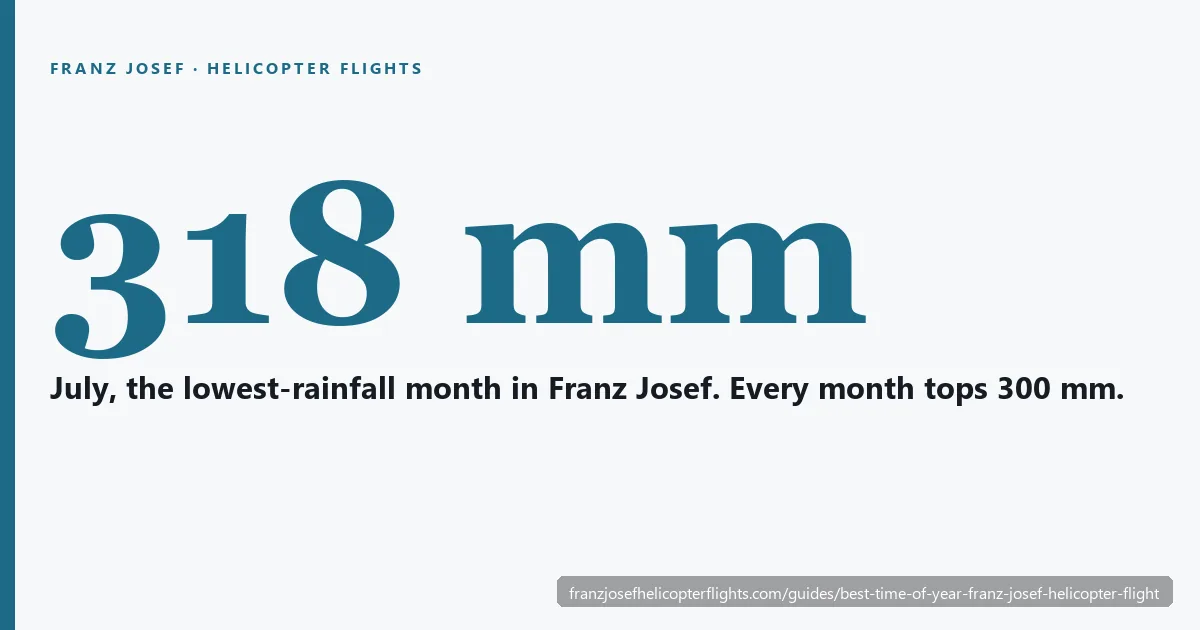
Every month in the record averages more than 300 mm. October and December are the wettest, at about 594 mm each. July is the lowest at about 318 mm, and February comes second at about 358 mm. Read these totals as a pattern for planning; they cannot forecast your day.
There is no rain-day count for Franz Josef itself. Hokitika Airport, on the coast 135 km north and about half as wet, has the nearest published count: its fewest rain days come in February (about 11) and its most in October (about 18). That pattern loosely matches Franz Josef’s rainfall, but it is a different place.
A monthly total also says nothing about whether the helicopters can fly on a given morning. Glacier Country Helicopters says the township and the Alps can have quite different weather, and that rain, wind and cloud all matter. A local operator’s blog says winter brings clearer days, and July’s low rainfall fits that claim, but no meteorological source confirms it.
Sunshine hours at the Franz Josef station are low and may come from a short or sheltered record. Read them only as a relative pattern: January to March are the sunniest months in the record, and June and December the dullest.
Daylight, cold and snow on the landing sites
Flights normally run within daylight. Glacier Helicopters says departures are typically between 8am and 5pm, season and weather dependent, and HeliServices flies during daylight hours, which change through the year. Near the June solstice the sun rises at about 8:10am and sets at about 5:10pm, so in midwinter the typical 8am-5pm window takes up almost all the daylight, and a late-afternoon slot sits close to dusk. In December the sun is up from before 6am until after 9pm.
New Zealand’s clocks go forward on the last Sunday in September (27 September 2026) and back on the first Sunday in April (4 April 2027).
Average highs in the village run from about 20°C in January and February to about 12°C in June and July, with July nights near 3°C. The landing sites are colder still. HeliServices says it can be 5-10°C cooler on the snow than in the village; Glacier Country Helicopters says “a couple of degrees”, and INFLITE says its Mt Cook landing sites are 1-3°C cooler. Glacier Country Helicopters asks you to bring a jacket in winter, and nobody lends clothing for a scenic flight. The what to wear guide applies in every month.
Summer has a landing caveat. The GetYourGuide listing for Glacier Country Helicopters’ 25-minute flight says that “in the summer this snow landing may become an alpine landing if no snow is available”. DOC adds that climate change is reducing snow cover at some of the park’s 18 approved landing sites. If snow under your feet matters on a summer trip, read snow landing vs alpine landing before you book.
Heli-hikes run year-round too. Franz Josef Glacier Guides describe winter as “a quieter, more intimate experience” and add extra insulation layers to the kit. In winter The Helicopter Line steers children to departures from 11am onward, because early-morning ice carries more risk.
Franz Josef month by month
Temperatures and rainfall are the village’s 1991-2020 averages (Wikipedia, citing NIWA CliFlo). Daylight is the sunrise-to-sunset length on the 21st of each month in 2026, calculated for Franz Josef, accurate to about two minutes.
| Month | Average high | Average low | Rainfall | Daylight on the 21st | What it means for a flight |
|---|---|---|---|---|---|
| January | 20.0°C | 10.5°C | 552 mm | 14 h 52 | Peak season; long days; sunniest stretch of the record begins; summer landing caveat |
| February | 20.5°C | 10.4°C | 358 mm | 13 h 33 | Second-lowest rainfall; still peak season; book a month ahead |
| March | 18.9°C | 9.3°C | 397 mm | 12 h 10 | Still in the busy November-March window; days shortening |
| April | 16.7°C | 7.8°C | 389 mm | 10 h 40 | Clocks go back on the first Sunday; two weeks’ notice usually enough |
| May | 14.5°C | 6.0°C | 471 mm | 9 h 29 | Cooler, wetter than April, quieter |
| June | 12.2°C | 4.1°C | 456 mm | 8 h 57 | Shortest days; fewest sunshine hours; bring a jacket |
| July | 11.9°C | 3.3°C | 318 mm | 9 h 24 | Lowest rainfall of the year; cold; quieter season |
| August | 12.6°C | 3.7°C | 427 mm | 10 h 34 | Days lengthening; cold on the snow |
| September | 13.7°C | 4.9°C | 520 mm | 12 h 01 | Wetter again; clocks go forward on the last Sunday |
| October | 14.9°C | 6.2°C | 594 mm | 13 h 30 | Wettest month (with December); most rain days at Hokitika |
| November | 15.9°C | 7.5°C | 481 mm | 14 h 49 | Busy season starts; book a month ahead |
| December | 18.4°C | 9.4°C | 594 mm | 15 h 24 | Longest days; wettest month (with October); peak season |
The busy-season notes come from the operators: Franz Josef Glacier Guides give December to February as peak season, and Glacier Helicopters says November to March is its busiest time, when it suggests booking a month ahead, against two weeks the rest of the year.
The trade-offs season by season
Summer: December to February
You get the longest days and the warmest weather of the year. February is the second-driest month in the record. The costs are crowds, a month’s notice for booking, December’s heavy rain and a chance of a rocky alpine landing on the shortest flights. A longer flight with more route options, or one that lands directly on a glacier, suits a summer visit best.
Autumn: March to May
March keeps summer’s long evenings, with about 12 hours of daylight on the 21st, and is still inside the busy window. April and May bring cooler air, fewer visitors and shorter days, and rainfall rises again into May. A flight booked two weeks out is usually enough from April.
Winter: June to August
Winter has the year’s lowest rainfall in July and fewer visitors, and Franz Josef Glacier Guides keep running heli-hikes through it. You trade that for days of nine to ten and a half hours, the coldest landings of the year and a flying window that fills most of the daylight. Book a morning flight so a delayed one still has daylight to work with, and dress for cold on the snow.
Spring: September to November
Spring is the wettest stretch of the year. September and October together average more than a meter of rain, October has the most rain days at Hokitika, and November opens the busy season. Daylight grows fast after the clocks change in late September. If spring is your only window, the spare day matters more than ever.
Booking ahead and keeping a spare day
Book once your dates are fixed. A month ahead covers November to March, two weeks the rest of the year, and Glacier Helicopters takes no online bookings within 24 hours of a flight. Every GetYourGuide listing on this site has free cancellation up to 24 hours before, so an early booking costs you nothing if your plans move.
Put the flight on your first day and keep the next one free. Every operator recommends it, and Franz Josef Glacier Guides suggest at least two days for a heli-hike. The weather and cancellations guide explains what happens to your booking if the call goes against you, and the best time of day guide covers which departure to pick.
For a short flight in any season, the Glacier Helicopters Franz Josef Glacier Helicopter Flight with Snow Landing is a 20-minute flight from the township with a snow landing, rated 4.9 from 57 GetYourGuide reviews. The snow landing flights page compares it with the other short flights, and the prices page shows what each flight type costs.
Questions about the best time to fly
What is the best month for a Franz Josef helicopter flight?
No month is clearly best. July had the lowest average rainfall in the 1991-2020 record and is quieter, but it is cold with short days; February is the second-driest month, with long days but peak-season crowds.
Can you fly to Franz Josef Glacier in winter?
Yes. HeliServices flies year-round, seven days a week, and Franz Josef Glacier Guides run heli-hikes all year. Departures depend on daylight, which drops to about nine hours in June.
Is there snow on the landing in summer?
Not on every site. Glacier Country Helicopters’ 25-minute listing warns that its summer landing may be an alpine landing if no snow is available.
How far ahead should I book?
About a month ahead from November to March and two weeks ahead the rest of the year, per Glacier Helicopters.
Related reading:
Pick a Morning Above the Glacier
Flights run on the weather. Book early in your stay so a cancelled slot can move to the next day.
Check Availability & Book